AERA 2025 Conference

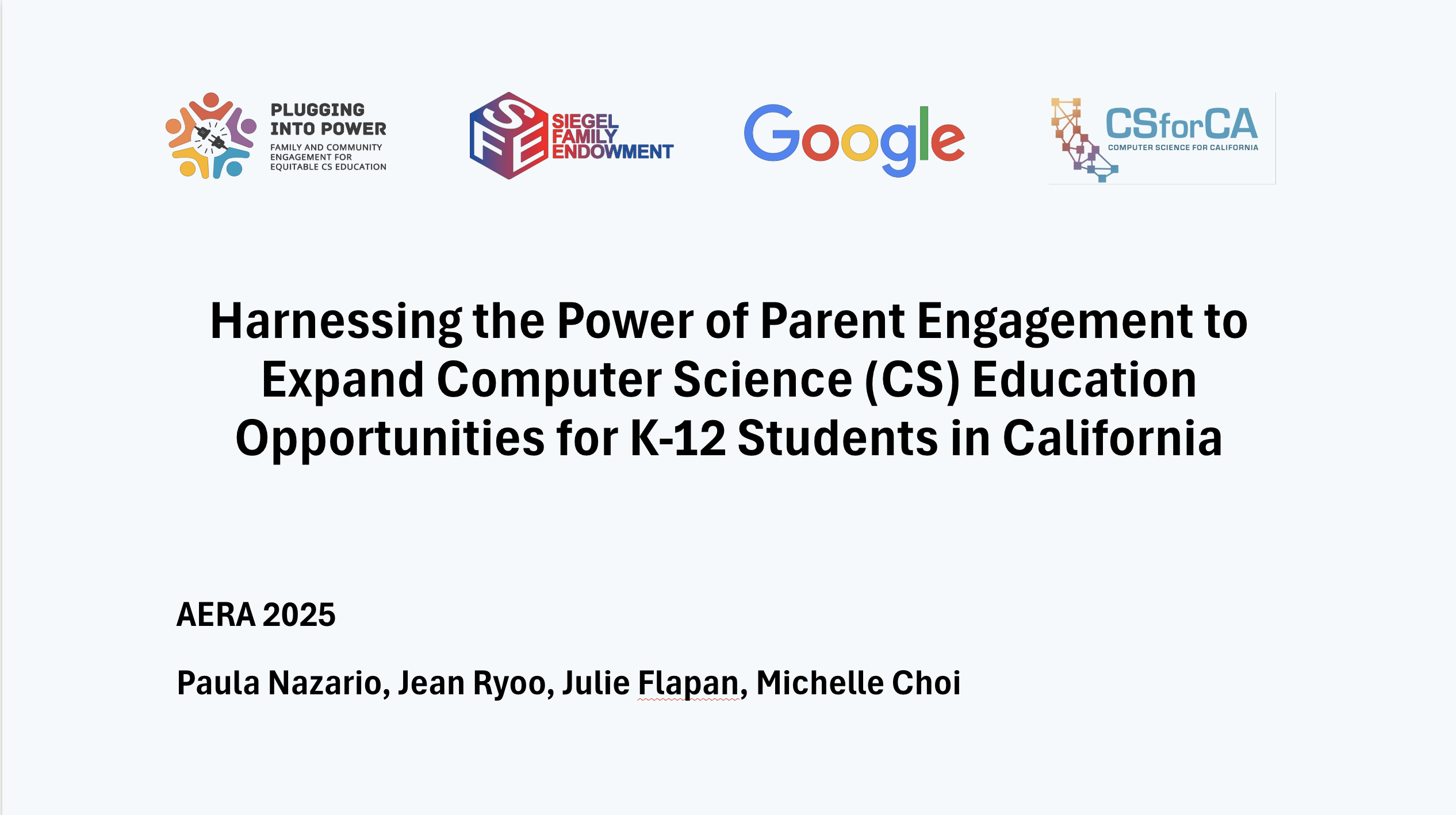
At the 2025 American Education Research Association (AERA) Conference which took place in Denver on April 23-27, 2025, Paula Nazario, Jean Ryoo, Julie Flapan, and Michelle Choi presented on a research project to explore how parents can help expand K-12 CS education as advocates on behalf of their children and all students to receive quality CS learning opportunities in school.

Click on the image below to view the presentation:

Insights from the Field: 10 Takeaways from Our Graduating Leaders

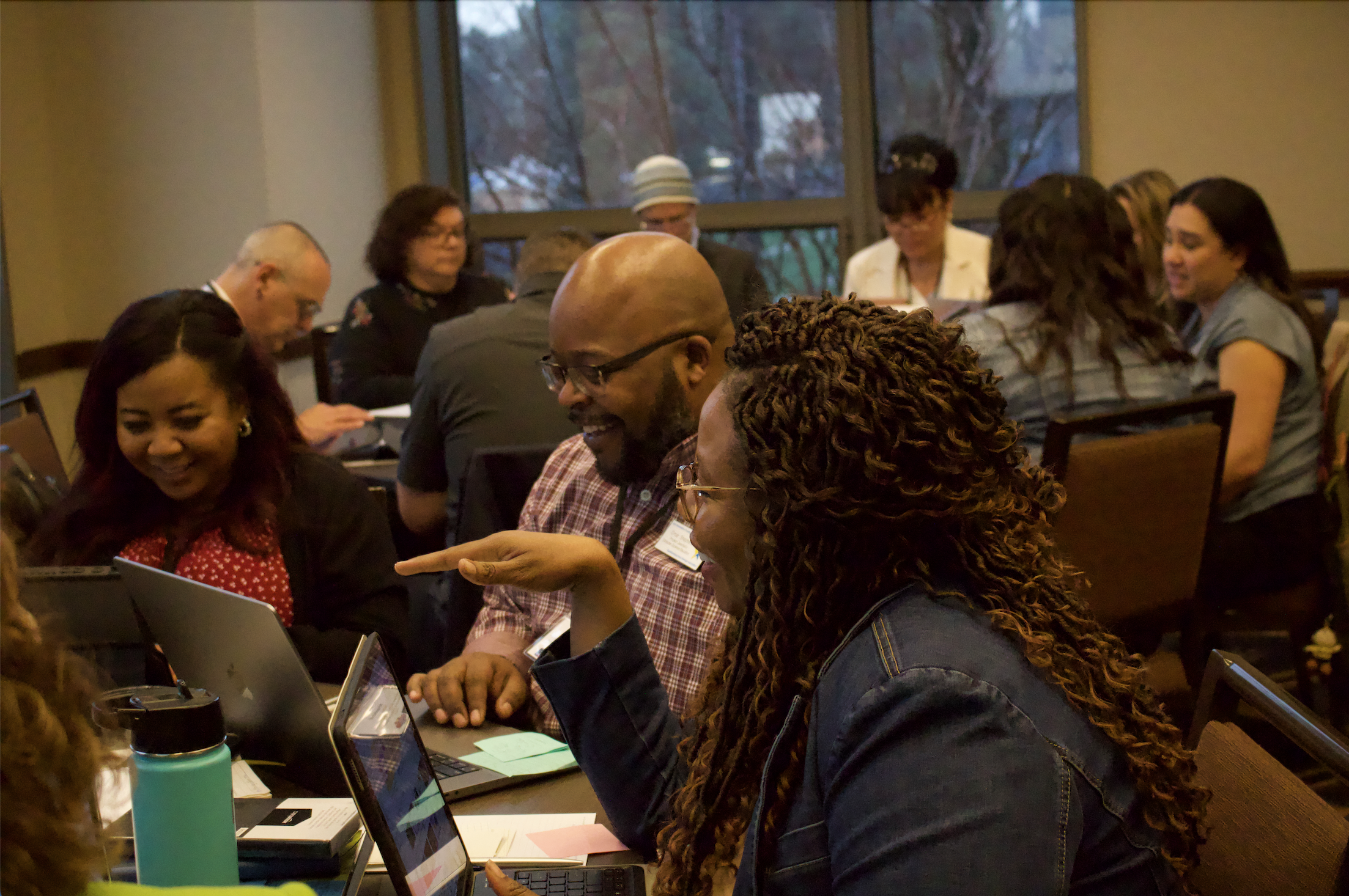
As much as we know that teachers are key to equitable implementation of computer science in their classrooms, we also know that school leaders hold the locks. In an effort to address obstacles facing teachers to expand access to computer science education, CSforCA co-created a workshop designed by and for school leaders. The centerpiece of this equity-focused workshop is the CS Equity Implementation Guide to help troubleshoot common dilemmas. We encourage school leaders looking to drive computer science education in California to explore this resource, along with our top ten takeaways from the workshop:

  1. Find a community of like-minded leaders to support you and learn together on your CS journey.
  2. Use local and state data to examine patterns of who has access to CS in your region or school.
  3. Develop an action plan with clear goals to keep you on track to expand access and equity.
  4. Explore the history of equity and access in CS, like Jane Margolis’s book Stuck in the Shallow End or the graphic novel Power On!
  5. Support your teachers by signing them up for Seasons of CS, a yearlong computer science professional development program.
  6. Join your local chapter of Computer Science Teachers Association, a supportive environment for K-12 CS educators.
  7. Partner with your local higher education institutions to take advantage of pre-service teacher education opportunities, including the CS supplementary authorization.
  8. Integrate computer science with other disciplines leveraging the Math, Science, Computer Science Partnership Grant and the California Subject Matter Projects.
  9. Sign up with the CSforCA coalition and advance efforts to broaden participation in computing.
  10. Spark joy in learning CS!

School leaders play a pivotal role in the success of computer science education. While working as change agents within the CS education landscape, school leaders are able to assist in unlocking some of the gates that have been barriers within their systems. School leader Darren Alcala shared, “Systems of support are needed. Without them, there is a cog in the system that is missing. This can be accomplished when both teachers and school leaders can see the value of CS education.”

2024-25 California Computer Science Education Budget Summary

In June, California finalized and enacted its 2024-25 budget. Despite facing a significant deficit, California's budget demonstrates a continued commitment to K-12 education equity across the state. While the budget doesn't introduce new computer science-specific funding, it does maintain support for key initiatives that benefit CS education and drive equitable, high-quality experiences for all students.

Read on to learn more about this year’s budget and how it can help foster accessible CS learning pathways in California.

WHAT WE'RE CELEBRATING

WE CAN’T LOSE SIGHT OF EQUITY — AND PLANNING FOR WHAT’S NEXT: 

California has a long history of commitment to computer science education. Programs like the Strategic Implementation Plan for Computer Science and Computer Science Standards demonstrate our legislature’s deep understanding of the need for equitable, accessible CS learning pathways. However, less than half of California schools offer computer science classes. 34% of schools serving high proportions of Black, Indigenous, Latinx, and Pacific Islander students offer CS courses in comparison to 52% of schools serving a greater proportion of white and Asian students. 

The budget is a pivotal component of the CS education landscape in California—and budgetary adjustments in ​​K-12 funding for computer science can help the state pave the way for more equitable learning outcomes. California must support the continuation and expansion of equity-centric professional development programs for CS educators. The Educator Workforce Investment Grant (EWIG) funds Seasons of CS, which provides computer science professional learning opportunities for thousands of California teachers, leaders, and counselors. When this funding ends next year, we call on state officials to ensure its sustainability and provide the necessary ongoing support educators need. This summer, the program’s CSPD Week convened educators from 35 counties across California for an in-person professional learning experience guided by the vision that all students should learn CS and all teachers can teach CS.

CSforCA continues to work with Governor Newsom and advocates in the legislature to explore policy initiatives—within and outside of the budget—that support equitable CS learning for all students. To meet the digital moment, California must work towards ensuring all high schools offer computer science—and that state-sponsored professional learning prepares high-quality, diverse teachers to teach it. Our state must prioritize clear and consistent data collection on CS implementation to identify and close equity gaps in order to prepare every student for college, careers, and community engagement. 

California has proven its dedication to CS education—and by continuing to take steps forward through the budget and policy, our state can create thriving CS learning environments for every student. Especially in this 21st century world, all students—regardless of background—deserve to learn the computational thinking skills necessary to navigate online life with confidence.

Computational Thinking for Parents and Families

Are you a parent interested in bringing basic computing skills to your kids? The UCLA Computer Science Equity Project’s own Roxana Hadad and Sharisa Chan, both computer science educators and moms with littles, share one of their favorite activities they like to do at home with their kids that you can do, too!

Parents, we know you want to continue the great learning your kids are doing in school while at home. Finding fun ways to teach digital skills can help kids develop their identities as computer scientists and STEM-seekers. As parents and educators ourselves, we want our little ones to learn these important skills, but we’re not crazy about them spending tons of time in front of their devices, so we look for engaging, accessible, and easy-to-do activities that don’t require a computer.

We’re excited to share free (or low-cost) unplugged computational thinking (CT) activities we’ve used to engage our kids. These different problem-solving strategies can spark interest in computing, and connect to their learning in other subjects such as math, science, and English. CT goes beyond coding—it is a powerful approach to thinking about problem-solving that helps people break complex challenges into manageable steps and come up with creative solutions. 

CT and computer skills aren’t just for programmers; they involve valuable techniques and mindsets for anyone navigating our increasingly digital world—especially little ones! Following a recipe step-by-step or reading a map are examples of the kinds of skills that are also used when developing a computer program.

When children practice computational thinking, they develop skills that help them tackle everyday problems, work together with others, and think creatively. This is especially important for kids from diverse backgrounds, as it helps bridge gaps and ensures everyone has a fair chance to shine. As children continue to develop their CT skills, they can gain the confidence to take on all kinds of new challenges. 

Read on for a fun computational thinking activity you and your little ones can do at home: How Does Your Garden Grow?:

Why Computer Science Education Is Essential To The Success Of Our Students And State

Computer science affects every industry, person, and global problem in the 21st century. Digital tools help solve modern-day problems – from debunking misinformation, to developing sustainable agriculture, to sequencing the human genome.

As technology continues to expand, California’s students need accessible, culturally relevant computer science education. However, disparities in computer science course offerings and enrollment on the basis of gender, race, and socioeconomic status prevent equitable outcomes for California students. 60% of California’s high schoolers are Black, Latinx, and Native American/Alaskan Native students, but only 16% take AP Computer Science. Less than 30% of the students taking CS courses are girls. As a state, California must ensure equitable and accessible computer science education, addressing demographic disparities and expanding opportunities for students of color, girls, and students in low-income and rural communities.

California has made meaningful progress in access to and participation in computer science – from spearheading the Educator Workforce Investment Grant to passing legislation expanding computer science credentialing pathways for teachers. But even as the home to Silicon Valley and technological capital of America, our state lags behind in CS education equity. Here at CSforCA, we’re committed to advancing equitable computer science education through a variety of different pathways – from policy changes, to research and communications, to educator professional development.

Bridging equity gaps in California requires structural changes that account for the diverse needs of students across our state. California must invest in the essential infrastructure – qualified educators, adequate funding, and robust professional development programs that will allow students learning computer science to be properly supported. Additionally, programmatic updates in the form of smart curriculum, standards, and teacher credentialing pathways will ensure that CS education stays comprehensive and culturally relevant. By prioritizing changes like these, California can create a robust and equitable CS education system that empowers all students to thrive in the digital age.

As a coalition of K-12 educators, nonprofit organizations, higher education, and industry leaders, CSforCA is actively pursuing these solutions, building the foundation to bring quality computer science education to every student in California.

Interested in joining us to advocate for high-quality, comprehensive computer science education in our state? Read our Take Action page or sign up to get involved.

Are You Excited About Advancing CS Equity in Your Community? Join CSforCA at Summer of CS!

We’re excited to co-host Summer of CS 2024 this year, and we can’t wait for you to join us! 

We know that all students can learn computer science… and we know that all educators can teach it. This summer, in partnership with UCLA Center X, the Sacramento County Office of Education, the San Bernardino County Superintendent of Schools, and the CDE Foundation, CSforCA will be hosting a professional development program for teachers, administrators, counselors, and all other educators who are curious about how to bring high quality computer science lessons to their schools and into their classrooms.

Join us throughout the summer for various workshops across California, with a stipend provided – including our in-person hallmark CS PD Week, which will take place in Anaheim from July 22 - 26, 2024 for K-12 teachers!

This interactive and community-driven programming includes summer workshops that build and strengthen CS education skills, academic year opportunities to enrich learning in real time, and virtual sessions to build supportive communities for both new and experienced STEM educators.

Hear from fellow educators on why they’re participating in this dynamic professional development opportunity:

No matter your level of experience with computer science - Summer of CS is designed for all educators. The program offers dynamic, ongoing, hands-on workshops for various grade levels and subject matters – from introductions to CS fundamentals to deep-dives into CS education leadership. This specific, tailored approach makes Summer of CS a convenient and welcoming opportunity for anyone interested in bringing computational thinking to students. 

This is an opportunity to join an active community of California computer science educators, building professional networks and sharing best practices. Summer of CS will continue to convene both in-person and online – to foster a collaborative environment this summer and through each season of the year. 

Summer of CS is the flagship moment of Seasons of CS, a research-backed professional learning program for K-12 educators who are interested in bringing computer science elements like digital literacy, critical thinking, and problem-solving to their students. This program helps educators and school leaders improve access, equity, and engagement in high-quality computer science education for English-learners, low-income, rural, Black, Latinx, and Indigenous students.

Register today at https://bit.ly/CSforCA_Summer24Workshops!

A Personal Reflection: CS, Social Justice, and the Complexity of the Israel-Hamas War

By Julie Flapan

This month marks the 30 days that my friends’s son, Hersh Polin-Goldberg, was severely wounded and kidnapped from the music festival in Israel, along with 240 hostages, still held captive in Gaza. The brutal terrorist massacre on innocent Jews by Hamas on October 7th is unconscionable.  The ensuing war, and heartbreaking attacks against innocent civilians and children—along with the rise of antisemitism and Islamophobia — is deeply concerning to everyone who values human life, in Israel and Gaza, and here at home.

While preparing my opening remarks for our CSforCA Summit, I felt nervous to discuss the Israel-Hamas war and my personal connection as a Jewish woman—recognizing that our multiracial/multiethnic coalition has many different perspectives that I didn’t want to offend. And, because it’s not directly related to computer science, I questioned whether it was appropriate for me to say anything at all.  

As I reflected on our typical practice in social justice spaces to contextualize computer science in the sociopolitical events of the moment— I struggled with why it is difficult to address the antisemitism I continue to feel around me. The collective grief many of us share for both Jews and Palestinians can make it difficult to know what to say and how to bring people together instead of driving people apart.

In my role as an advocate for equity in computer science, I often speak about the importance of examining technology’s ethics and its impact on society. In particular, what do CS ethics and impact mean in the backdrop of today’s war in the middle east and what role might technology play in how we view this conflict? We want to build students’ essential critical thinking skills to understand why your social media feed might look different than mine, how algorithms are created and by whom, and the biases baked into them by the data sets from which they are drawn. Let’s not forget the need to understand the role of technology in war, cybersecurity, and the accessibility and power of AI tools that reinforce an echo chamber of information and disinformation.

I am reminded of the binary foundations of computer science—and the recognition that the world is far more complex than zeros and ones, right or wrong, left vs. right.  I have spoken before about navigating nuance, and shining a light on the complexity of difficult issues, examining the gray area in-between and the possibility of holding two opposing truths at once.

As we expand access to culturally responsive computer science education where we center student voice, agency, and lived experiences, I hope we can equip our students to build empathy by exploring our own and other’s identities, perspectives, and historical narratives, with the goal of rejecting hate and finding peaceful solutions to life’s most pressing problems.

CSforCA presents at the ECEP Connect Virtual Summit

CSforCA presented at the ECEP Connect Virtual Summit, a convening hosted by the Expanding Computing Education Pathways Alliance where state teams, like CSforCA, have an opportunity to engage with ECEP’s model for state change and leverage its resources and network of state and national leaders to broaden participation in computing. Julie Flapan and Jen Rosato delivered an exciting presentation about Establishing Diverse State Computer Science Education Teams to Broaden Participation. Roxana Hadad also gave an insightful talk about Equity Unveiled: A Journey Through the Development of California’s and Nevada’s CS Equity Guides.

View Julie Flapan and Jen Rosato's ECEP Virtual Summit Presentation:

View Roxana Hadad's ECEP Virtual Summit Presentation:

California Governor Signs Commission on Teacher Credentialing Bill into Law

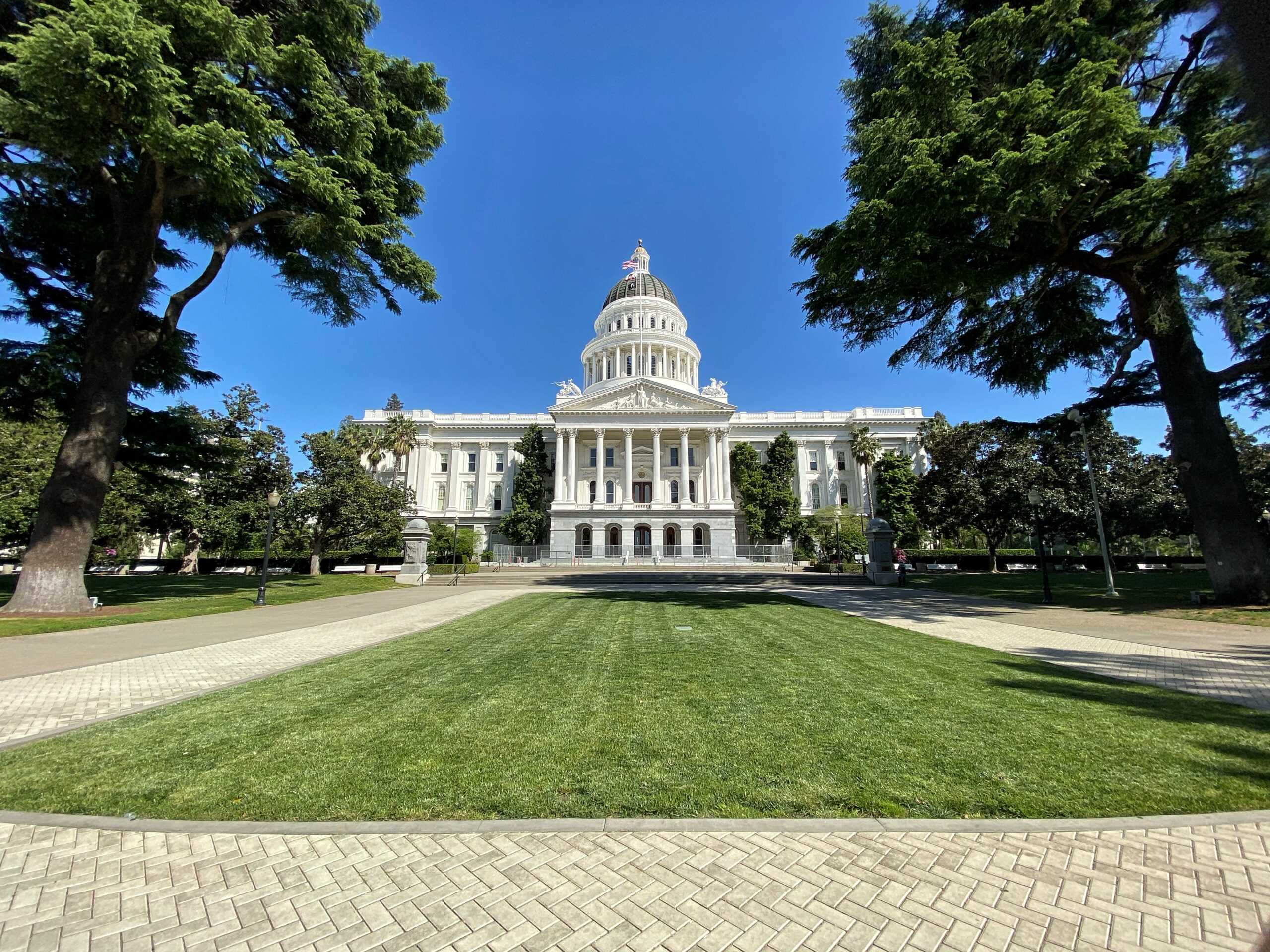
CSforCA is excited to announce that California Governor Gavin Newsom signed AB 1251 into law! Written by Assemblymember Luz Rivas, a computer scientist herself, AB 1251 will help broaden the computer science teacher pipeline to ensure all California students are able to learn foundational computer science skills. 

AB 1251 requires the California Commission on Teacher Credentialing to create a work group developing new, effective pathways that credential California teachers to teach computer science. By broadening the computer science teacher pipeline, AB 1251 will help increase equitable access for students across the state.

AB 1251 invites experts in the field – including school administration, researchers, and content experts – to collaborate and provide input. By including these diverse perspectives, the law ensures that the credential pathways created are responsive and realistic for teachers in order to expand access to high quality learning for students. The law helps close equity gaps, working towards a future where all students have access to high-quality CS instruction regardless of their zip code or background.

AB 1251 is a critical next step to increase accessibility for equitable CS education in California. By signing this bill into law, Governor Newsom is demonstrating an active commitment to advancing computer science education equity throughout the state, acknowledging that computer science is a foundational topic that must be accounted for in teacher preparation programs. By developing pathways that broaden the pipeline for high-quality educators, California can ensure equitable and accessible computer science education, address demographic disparities, and expand opportunities for students of color, girls, and students in low-income and rural communities.

Thank you to Governor Gavin Newsom and Assemblymember Luz Rivas for championing equitable, accessible computer science education at the state level! 

P.S. - You can read more about Assemblymember Rivas in her CS Spotlight.

How we can make access to computer science education in California more equitable

Far too often, zip-code and socioeconomic status determine whether California students have access to a computer science education — and those who don’t live in the right school district often miss out on this key opportunity to thrive in the digital future.

That's why the California State Senate must pass assembly bills 1054 and 1251. Every student deserves a quality computer science education.

Read the full op-ed "How to Make Access to Computer Science in California More Equitable" by CSforCA's Paula Nazario in EdSource.

CS Spotlight: Katherine Goyette Embeds Computer Science Education Equity Into School Systems

As we enter the digital age, it’s especially important that every student – regardless of gender, race, or income level, has access to high-quality computer science education. California Department of Education Computer Science Coordinator Katherine Goyette understands these intersections between access and opportunity in computer science, and is working on building a future where all students have the tools they need to succeed in a CS first world. Read on to learn more about her background, role, and passion for equity in the classroom. 

Tell us about your background. How did you get introduced to computer science?

Ever since I was a child I have been interested in how emerging technologies work and can be leveraged for both practical and artistic purposes. In the mid 1980s my father bought a Macintosh personal computer and I began creating turtle graphics using logo programming. Offering computer coding for kids wasn’t as common in the K-12 space at that time, but curiosity and passion led my learning as the years passed, whether it was through building a website on my own time or upgrading the hardware components in my laptop. When I later entered the public education space, I continually sought out ways to embed CS education equitably into the school systems in my sphere of influence.

Tell us about your work in the computer science education space.

Currently I am the Computer Science Coordinator for California. I continually seek out the voices and perspectives of educators, families, students, and communities from across the state, so that I may provide guidance and support that celebrates variability and builds upon the unique strengths and assets of each region, district, and school. It is by building the capacities of those we serve that we can create sustainable progress in CS education equity that is tailored to the identities of our students, families, and communities.

Why is CS education equity important to you?

Prior to my role at the California Department of Education, the majority of the students I served as a classroom teacher and administrator were the children of migrant farmworkers. Statistically, these students are in subgroups that are far less likely to have access to computer science education than other populations across the state. In order to best serve the needs of our diverse state, we must create CS opportunities for students who have historically been underrepresented. By ensuring widespread access to computer science education in California, we build our students' skills in evaluating technologies with a lens of equity in the classroom, identifying and investigating potential algorithmic biases, and utilizing computing for social justice.

What is ethical computing and why is it important to teach?

It is vital that we create CS opportunities for students in a way that teaches them to be critical consumers and ethical creators of computing technologies. Technology is a tool that can promote social justice and positively impact society. However, it also has the potential to be used nefariously. Our students must learn to understand that AI may provide incorrect information, algorithms may have bias, and it is our responsibility as humans to control and monitor computing devices, to promote a healthy use of computing technologies for the benefit of humanity.

What is the value of computer science education for all students?

As California's state board adopted standards documents indicate, computer science is to be considered a core subject for grades K12, and guaranteed as an opportunity for all students. Computer science contains foundational concepts that support a well-rounded education for all, which goes far beyond coding. As students engage in CS education, they learn how computing systems work together, analyze and evaluate data, consider benefits and security challenges of online spaces, and participate in program planning and troubleshoot errors in code. These concepts prepare students to actively participate in our digitally connected world as resourceful, knowledgeable, ethical citizens.

To learn more about the work that the California Department of Education is doing to make CS a priority, read about the Computer Science Content Standards Development.

CSTA 2023 Conference

Lauren Aranguren, Julie Flapan, Roxana Hadad, Steve Kong, Sophia Mendoza, Paula Nazario, and Jean Ryoo presented at this year’s CSTA 2023 Conference about supporting CS educators through equitable leadership practices in California. Presenters introduced the SCALE-CA (Supporting Computing Access, Leadership and Equity in California) model of advocacy, emphasizing its impact in the classroom. They also shared case studies, the CS Equity Guide, and Seasons of CS as professional learning opportunities. Read the presentation slides below.

View the CSTA 2023 Conference Presentation:

CSTA 2023 Conference Presentation